
Finding an easy knitted dog sweater pattern isn’t always as simple as it sounds. Many patterns labelled “beginner friendly” still include shaping, complicated stitch counts or techniques that can be frustrating if you’re just starting out. Choosing a simpler design helps you build confidence while making something your dog will actually wear.
I made four dog sweaters before I managed one that actually fit. The first looked fine on the needles. On the dog, it rode up, twisted sideways, and came off during the first walk. The second was too tight around the chest. The third had leg holes in the wrong place. The fourth worked because I finally stopped trying to follow complicated shaping and stuck to something simpler.

What Makes a Dog Sweater Pattern Easy
An easy pattern has fewer moving parts. It uses basic stitches, minimal shaping, and straightforward construction. The fewer times you have to increase, decrease, or count complicated stitch patterns, the less likely something goes wrong.
Here is what separates beginner-friendly patterns from ones that look deceptively simple but cause problems:
- Worked flat on straight needles rather than in the round: Circular needles and double-pointed needles add an extra layer of difficulty if you are not used to them. Flat knitting lets you see what you are doing and makes it easier to fix mistakes as you go.
- Minimal or no shaping: Patterns that rely on increasing and decreasing stitches to create curves around the chest or neck require more attention and leave more room for error. Rectangular or simple tube shapes avoid this entirely.
- Basic stitches only: Garter stitch, stockinette, or simple ribbing. No cables, no lace, no textured patterns that require you to keep track of which row you are on.
- Few seams: The more pieces you have to knit separately and join together, the more chances you have to misalign something. One or two seams is manageable. Four or five becomes fiddly.
If the pattern includes phrases like “pick up and knit,” “short rows,” or “kitchener stitch,” it is not a beginner pattern no matter how it is marketed.
Before you start knitting, it’s worth understanding how a dog sweater should fit. Read my article on choosing practical dog clothes to learn what makes dog clothing comfortable, safe and easy for your dog to wear.
Easy Knitted Dog Sweater Patterns for Beginners
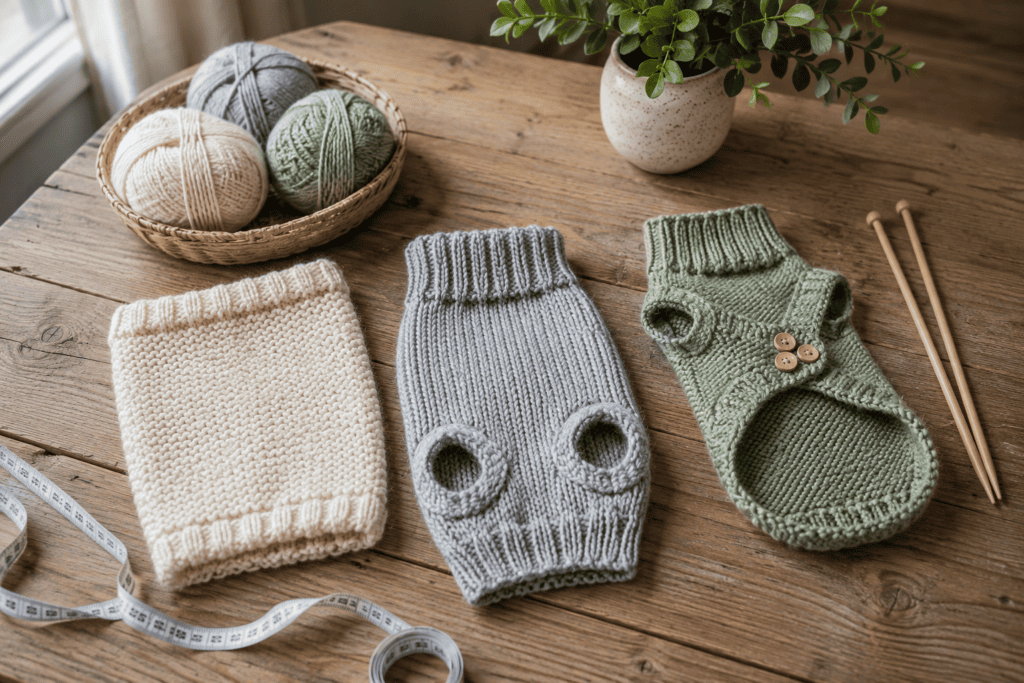
If you’re new to knitting for dogs, start with the simplest construction rather than the fanciest design. These beginner-friendly knitted dog sweater patterns use basic stitches, minimal shaping and straightforward construction, making them much easier to finish while still keeping your dog warm and comfortable.
Rectangular Belly Band Pattern
This is the simplest version you can make. It is a rectangle that wraps around the dog’s chest and belly, fastened with buttons, Velcro, or ties. No leg holes. No neck shaping. Just a flat piece of knitting that does the job.
You need chunky or aran weight yarn, needles to match the yarn weight, and a tape measure. Measure around the widest part of your dog’s chest, then add about two inches for overlap and fastening.
Cast on enough stitches to match that measurement when worked in garter stitch or ribbing. Knit every row if using garter stitch, or alternate knit and purl rows if using rib. Keep going until the piece is long enough to cover from just behind the front legs to the start of the back legs. Cast off, weave in the ends, and attach your fastener of choice along one short edge.
This works best for smaller dogs or dogs with short legs. Larger dogs with deep chests need something that stays in place better, which usually means leg holes.
Simple Tube Sweater with Leg Holes
This pattern adds leg holes to a basic tube shape, which stops the sweater riding up or twisting during a walk. It is still beginner-friendly because the shaping is minimal and the construction is straightforward.
Measure your dog’s chest, neck, and the distance from neck to tail. Cast on enough stitches to fit comfortably around the chest, worked in rib or garter stitch for stretch. Knit in the round or flat, depending on your comfort with circular needles. If working flat, you will seam it later.
When you reach the point where the front legs sit, leave gaps for the leg holes by binding off a small number of stitches on each side, then casting them back on in the next row. This creates openings without requiring complicated increases or decreases. Continue knitting until the piece is long enough to cover the back, then cast off.
If you worked it flat, seam along the belly. If you worked in the round, you are done. The leg holes do not need to be perfectly placed. Dogs adjust. As long as the sweater covers the back and chest without pulling tight across the shoulders, it works.
Adjustable Strap Sweater
This version uses a knitted back panel with separate straps that go under the belly and fasten with buttons or clips. It removes the need to get the chest measurement exactly right because you can adjust the fit after the fact.
Knit a rectangular panel that covers the dog’s back from neck to tail. The width should be enough to drape down the sides without being tight. Use garter stitch or a simple rib so the piece has some give.
Separately, knit two long strips for the belly straps. These attach to the back panel at the chest and behind the front legs. You can sew them on permanently or attach them with buttons so you can adjust placement depending on how your dog wears it. Fasten the straps under the belly with Velcro, snap fasteners, or toggles.
This design works well for dogs with deep chests or barrel-shaped bodies because the straps prevent the sweater sliding backwards while still allowing movement. It also makes it easier to get the sweater on and off, which matters if your dog is not keen on having things pulled over their head.
Prefer crochet instead of knitting? Take a look at my article on free crochet dog patterns for more beginner-friendly ideas.

Common Mistakes Beginners Make
I have seen patterns labelled as beginner-friendly that include lace edging, intricate stitch patterns, or shaping that requires counting increases across multiple rows. Those are not beginner patterns. They are intermediate patterns dressed up to look accessible.
- Using yarn that is too thin: Fingering or sport weight yarn takes much longer to knit and shows mistakes more clearly. Chunky or aran weight yarn works up faster and hides uneven tension better.
- Trying to match a complicated size chart: Some patterns give measurements for six different sizes with specific stitch counts for each. This adds confusion. Measure your dog, knit a test swatch to check your tension, and adjust the stitch count yourself rather than following a chart that may not fit your yarn or your dog.
- Starting with a pattern that requires seaming multiple pieces: Sweaters with separate sleeves, collars, or panels that get sewn together later are much harder to assemble neatly. Stick to one or two pieces maximum.
- Ignoring gauge: If your tension is tighter or looser than the pattern assumes, the finished piece will not fit. Knit a small test square first, measure it, and adjust your needle size if needed.
Most dogs do not care if the sweater is perfectly symmetrical or if the stitches are completely even. They care whether it is comfortable and stays on. That gives you a lot of room to work with as a beginner.
Choosing Yarn and Needles
Use machine-washable yarn unless you want to hand-wash a dog sweater every time it gets muddy. Acrylic, acrylic blends, or superwash wool all work. Avoid anything that felts, sheds heavily, or requires delicate care.
Chunky weight yarn on 5mm to 6mm needles is the easiest combination for beginners. It knits up quickly, covers more ground per row, and is more forgiving of uneven tension. Aran weight on 4mm to 5mm needles also works if you want something slightly lighter.
Straight needles are fine for flat knitting. If you want to try knitting in the round, a circular needle with a cable length that matches your dog’s chest circumference makes it easier to manage. Double-pointed needles are not necessary for most dog sweater patterns unless you are knitting something very small.
Getting the Fit Right
Measure your dog while they are standing. You need chest circumference at the widest point, neck circumference, and length from the base of the neck to the base of the tail. If the pattern includes leg holes, measure the distance from neck to where the front legs start.
Knit a test swatch before starting the full piece. Cast on twenty stitches, knit ten rows in your chosen stitch pattern, then measure how many stitches and rows fit into ten centimetres. Use that to calculate how many stitches you need to cast on for your dog’s measurements.
Dogs come in different shapes even within the same weight range. A Greyhound and a Bulldog might weigh the same but have completely different chest depths and leg placements. If your dog has a deep chest, short legs, or a long back, you will likely need to adjust any standard pattern.
Try the sweater on your dog before you finish it. If it is too tight, you can add extra rows or stitches. If it is too loose, you can take it in with a seam or add elastic to the edges. Fixing it partway through is easier than realising it does not fit after you have cast off and woven in all the ends.
Finishing Your Dog Sweater
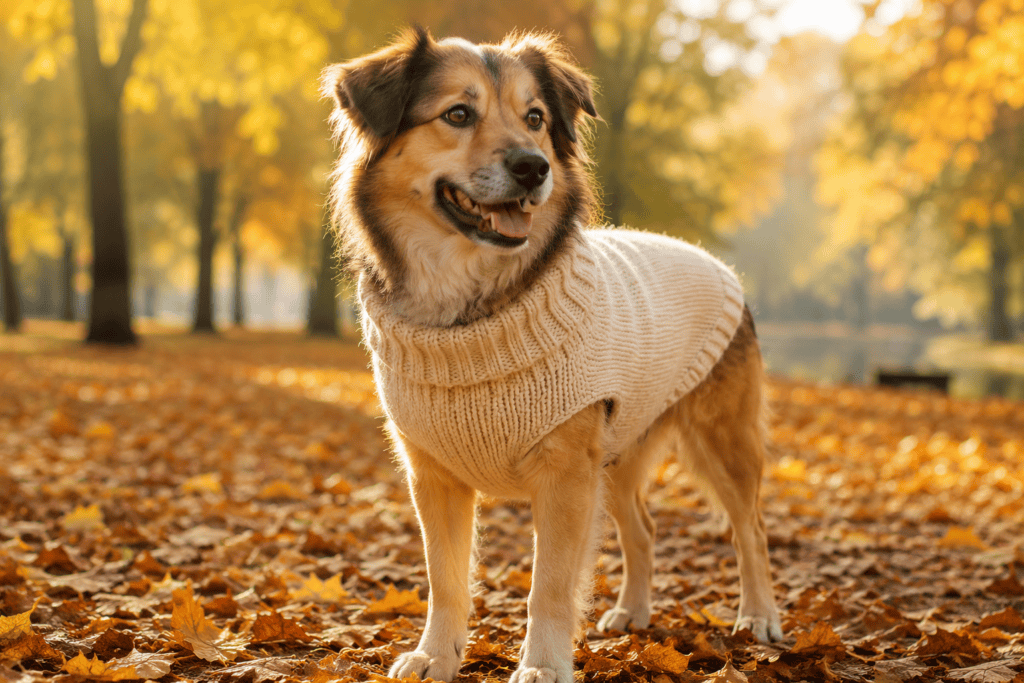
Once you’ve finished knitting, a few final steps will help your dog sweater last longer and fit more comfortably. Taking the time to weave in loose ends, sew neat seams and choose the right fastening makes a big difference to how well the finished sweater wears.
If the pattern requires seaming, use mattress stitch or whip stitch depending on the edge. Mattress stitch gives a neater finish but takes longer. Whip stitch is faster and works fine for something functional like a dog sweater. Do not pull the seams too tight or they will pucker and restrict movement.
For fastenings, Velcro is the easiest to use and adjust. Sew-on Velcro strips work better than adhesive versions, which come off in the wash. Buttons and buttonholes look neater but take more time to add and are harder to adjust once in place. Snap fasteners are a middle ground but can pop open if the sweater is pulled.
Toggles or ties made from the same yarn give a handmade look but are less secure and can come undone if the dog rolls or rubs against something. Use them only if the sweater fits snugly enough not to need much fastening.
Choosing the Right Style for Your Dog
Small dogs with short coats and high energy levels need sweaters that stay in place during movement. A tube sweater with leg holes or an adjustable strap design works better than a belly band that shifts around. Older dogs often benefit from an extra layer of warmth during colder weather. If you’re not sure whether your dog is considered a senior yet, use the Dog Years to Human Years Calculator to find out.
Dogs with thick necks or wide chests often struggle with pullovers that have to go over the head. A back panel with belly straps or a design that fastens along the side makes it easier to get the sweater on without wrestling. Long-backed dogs need extra length, which you can add by knitting more rows before casting off. Short-legged dogs need the belly section kept short or it drags on the ground.
If your dog has never worn a sweater before, start with something lightweight and simple. Get them used to the feeling before you spend hours knitting something more complicated that they refuse to wear.
Making It Work
The simplest patterns are often the most useful. A rectangle that wraps around the chest and fastens with Velcro will keep a dog warm just as well as a complicated fitted design with cables and a hood. The difference is how long it takes you to make and how much room there is for mistakes.
Start with the easiest version that suits your dog’s shape and your knitting skill. If it works, you can try something more fitted next time. If it does not, you have lost less time and yarn than you would have on a complicated pattern that went wrong.
A knitted sweater is just one way to keep your dog comfortable in colder weather. If you’re looking for more ideas I’ve put together 12 stylish dog outfit ideas for every season and occasion, with options for everything from everyday walks and wet weather to colder months and special occasions.
This article is for informational purposes only. For advice specific to your dog always speak to your vet.